

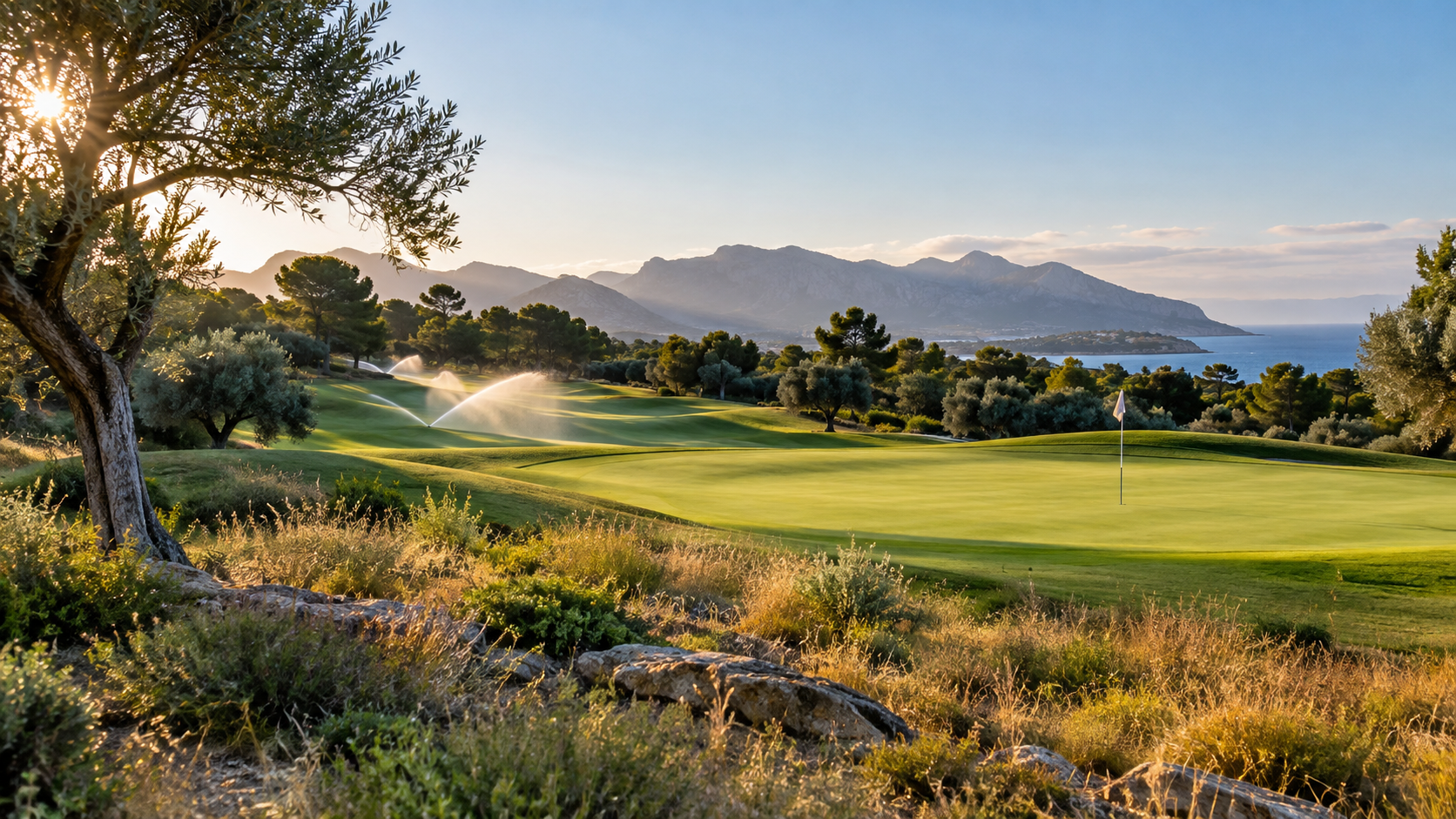
Keeping a golf course green in a Mediterranean climate inevitably raises questions about water. On Mallorca, where hot summers, limited rainfall and pressure on natural water resources are part of island life, those questions are particularly relevant. Yet the way Mallorca’s golf courses are irrigated is often very different from what visitors might assume.
Reclaimed wastewater has become a fundamental part of golf course management on the island. According to the Balearic Government’s water authority, reclaimed water is currently reused for irrigation on 22 golf courses in Mallorca, accounting for approximately 7.93 million cubic metres per year. At the same time, individual clubs are increasingly reducing irrigated areas, restoring Mediterranean vegetation and adapting course maintenance to the realities of Mallorca’s climate.
The result is a gradual change in what sustainable golf on Mallorca looks like. It is no longer simply about keeping fairways green with a different source of water. It increasingly involves deciding where grass is actually necessary, where nature should be allowed to return and how a golf course can function as part of the surrounding Mediterranean landscape.
Reclaimed water is central to golf on Mallorca
The most important fact in the discussion about golf and water on Mallorca is the source of irrigation water. Under the current Hydrological Plan of the Balearic Islands, golf courses are generally required to meet their irrigation needs with reclaimed water.
Reclaimed water is wastewater that has already passed through treatment and then undergoes the necessary processes to make it suitable for a new use. Instead of using drinking water or placing additional pressure on natural groundwater reserves, this water can be reused for purposes such as agriculture, parks, gardens and golf courses.
The Balearic Government currently records reclaimed water being used for 22 golf courses on Mallorca. The combined annual volume is approximately 7.93 million cubic metres. This makes golf one of the established users of Mallorca’s water-reuse infrastructure rather than simply another consumer competing for conventional freshwater supplies.
The policy is not new. The Balearic Islands have been developing rules on alternative water supplies for golf courses for decades. The current Hydrological Plan for 2022–2027 reinforces this approach by requiring golf and polo courses to satisfy irrigation demand with reclaimed water, subject to the applicable regulatory framework and existing rights.
The water debate remains very much alive
Water management on Mallorca is not a theoretical environmental issue. Population growth, tourism, agriculture, periods of drought and increasingly demanding summer conditions all place pressure on the island’s water system.
This makes the rules governing golf particularly relevant. In 2026, golf organisations asked the Balearic authorities to reconsider the requirement concerning reclaimed water during consultations for future hydrological planning. The regional water authority rejected the proposal, maintaining the principle that reclaimed water should continue to play the central role in golf course irrigation.
For golfers visiting Mallorca, this background is worth understanding. A green fairway does not automatically mean that drinking water or groundwater has been used to maintain it. The island has created a regulatory system designed specifically to make treated wastewater part of the irrigation cycle.
Canyamel Golf: irrigating only where it matters
Canyamel Golf in the northeast of Mallorca provides a clear example of how this works in practice. The club states that its irrigation is based exclusively on recycled water supplied by the local wastewater treatment plant.
During the hottest summer months, Canyamel also reduces irrigation to the most important playing areas. This approach recognises that a golf course does not need every square metre to resemble a perfectly irrigated fairway.
Large non-playing areas are allowed to perform a different role. Native trees including holm oaks and fig trees are protected, while areas outside the playing corridors provide habitat for local plants and wildlife.
This creates an important distinction between golf course presentation and golf course quality. A sustainable Mediterranean golf course does not necessarily have to be uniformly green from boundary to boundary. Fairways, tees and greens can be maintained to high playing standards while peripheral areas reflect the dry conditions and natural colours of the surrounding landscape.
Son Antem is allowing Mediterranean nature to return
One of the most interesting developments in 2026 is taking place at Golf Son Antem near Llucmajor. The club is naturalising extensive out-of-play areas on its East Course as part of a move towards a more sustainable maintenance model.
The project focuses on restoring native vegetation in areas that are not essential to normal play. According to Son Antem, this reduces the need for irrigation, plant protection products and intensive maintenance while increasing habitat for local flora and fauna.
The change also alters the visual character of the golf course. Instead of maintaining large expanses of intensively managed grass, parts of the course increasingly blend into Mallorca’s natural environment.
For golfers, this can make a course more distinctive rather than less attractive. Mediterranean grasses, native plants and drier natural areas create contrast with the maintained playing surfaces and help give a golf course a stronger sense of place.
Less irrigated grass can also improve course identity
For decades, the visual ideal of golf was heavily influenced by courses in wetter climates. Perfect green grass extending far beyond the actual playing corridors became associated with quality, even in regions where maintaining that appearance required substantial resources.
That approach is increasingly being questioned in Mediterranean golf. Mallorca has its own landscape: pine forests, olive trees, holm oaks, scrub vegetation, rocky ground and grasses that naturally change colour during the dry season.
Allowing some of these characteristics back into a golf course can reduce maintenance requirements while making the course look more authentically Mallorcan. It also creates clearer transitions between intensively maintained playing areas and natural surroundings.
This does not mean abandoning course quality. Greens still need to put consistently, tees need appropriate turf and fairways need to provide suitable playing surfaces. Sustainability is more about concentrating resources where they genuinely contribute to the game.
Alcanada has developed its own environmental approach
Club de Golf Alcanada near Port d’Alcúdia has also documented a range of environmental initiatives. The club states that its irrigation water comes from the wastewater treatment plant in Alcúdia, connecting the golf course directly to the local water-reuse cycle.
Its environmental programme extends beyond irrigation. Alcanada has introduced solar panels on its golf buggy fleet, drinking-water refill stations to reduce disposable plastic bottles and charging facilities for electric vehicles.
The club has also used animals as part of landscape management. Donkeys kept near the 13th hole feed on vegetation and help clear undergrowth, reducing the need for herbicides in that area while also contributing to wildfire prevention.
Biodiversity projects include beehives and, more recently, the installation of nesting boxes designed to attract insect-eating bird species. In winter 2025, 30 nesting boxes were installed around the clubhouse and golf course as part of an ecological approach to the recurring problem of pine processionary caterpillars.
Water efficiency is about more than the source of water
Using reclaimed water solves only part of the equation. Even recycled water remains a resource that has to be treated, transported, stored and distributed. Efficient irrigation therefore remains important.
Modern golf course management increasingly focuses on applying water only where and when it is needed. Soil conditions, exposure to sunlight, wind, slopes and different turf areas can all influence irrigation requirements.
Reducing the size of irrigated areas is one of the most direct ways of reducing demand. Replacing intensively maintained grass outside the playing corridors with native or drought-tolerant vegetation can reduce both water requirements and maintenance.
This is precisely why naturalisation projects such as the one at Son Antem are relevant. They change the underlying maintenance model rather than simply searching for another way to supply the same amount of water.
Why Mallorca is particularly suited to naturalised golf
Mallorca’s landscape gives golf courses an advantage when moving towards naturalisation. The island already has a strong and recognisable visual identity that does not depend on lush green vegetation throughout the entire year.
Olive trees, pines, dry stone walls, native shrubs and golden summer grasses are part of the traditional Mallorcan landscape. Incorporating these elements into golf courses can reduce resource use while creating a stronger connection between the course and its location.
This matters from a tourism perspective as well. International golfers do not travel to Mallorca to experience a course that could be located anywhere in Europe. Sea views, Mediterranean vegetation, mountains, stone walls and the distinctive light of the island are part of the attraction.
A sustainable approach can therefore improve not only environmental performance but also the character of the golfing experience.
Brown does not necessarily mean bad course conditions
Golf travellers may also need to adjust their expectations. A course with natural brown grasses beyond the fairways or areas of dry Mediterranean vegetation is not necessarily poorly maintained.
In many cases, the opposite can be true. Restricting irrigation to the surfaces that directly affect play can be a deliberate maintenance decision. Natural rough and unirrigated zones can reduce water consumption while still allowing greens, tees and fairways to receive the attention they require.
Golf has traditionally placed considerable emphasis on appearance, but course condition and uniform green colour are not the same thing. What ultimately matters to the golfer is the quality and consistency of the playing surfaces.
Visitors who understand this distinction are likely to see the changing appearance of Mediterranean golf courses in a very different way.
Biodiversity has become part of golf course management
Golf courses occupy relatively large areas of land, but only part of that land is actively used during a normal round. This creates opportunities for habitats between holes and around the outer edges of the property.
Native vegetation can provide food and shelter for insects, birds and small animals. Trees can create ecological corridors, while ponds and less intensively managed areas can support additional species.
Canyamel Golf, for example, highlights the protection of native trees and Mediterranean tortoises as part of its environmental approach. Alcanada uses beehives and bird nesting boxes, while Son Antem explicitly identifies increased biodiversity as one of the benefits of its naturalisation programme.
These projects show how the discussion around sustainable golf has expanded. Water remains central on Mallorca, but biodiversity, energy consumption, chemical use, waste reduction and habitat management increasingly form part of the same strategy.
What does sustainable golf mean for visiting players?
For most golfers, the practical experience may appear relatively unchanged. The objective is still to provide good greens, playable fairways and a course that is enjoyable and challenging.
What may change is everything around those surfaces. Rough areas can become more natural. Native vegetation may replace maintained grass. Courses may allow seasonal colour changes instead of attempting to keep the entire property intensely green throughout the summer.
Players may also encounter refill stations instead of disposable plastic bottles, electric or solar-assisted course vehicles, wildlife areas and environmental restrictions designed to protect sensitive habitats.
These changes are not obstacles to a premium golf experience. When implemented properly, they can make the experience more authentic and more closely connected to Mallorca itself.
Sustainability also matters for Mallorca as a golf destination
Golf tourism is particularly valuable to Mallorca because much of the demand falls outside the traditional midsummer tourism peak. Spring and autumn are among the most attractive periods for golf, helping hotels, restaurants, rental-car companies and other tourism businesses extend activity beyond July and August.
But the long-term credibility of golf tourism also depends on how the sport uses local resources. Water is one of the clearest examples. On an island where water availability is closely monitored, courses must be able to demonstrate that their irrigation systems fit within a broader strategy of reuse and conservation.
Mallorca’s established use of reclaimed wastewater gives the island an important foundation. The next stage is increasingly about efficiency: reducing unnecessary irrigated areas, using vegetation adapted to the climate and managing courses in ways that require fewer resources.
A different idea of the perfect Mallorca golf course
The sustainable golf course of the future may look slightly different from the immaculate wall-to-wall green layouts that once represented the ideal.
On Mallorca, the more logical model is a course where excellent playing surfaces are surrounded by an unmistakably Mediterranean landscape: carefully maintained greens and fairways framed by pines, olive trees, native grasses, rocky ground and vegetation that can survive the island’s climate with less intensive intervention.
Projects already underway at courses such as Son Antem, together with water-management strategies at Canyamel and Alcanada, show that this transition is not merely theoretical. It is already visible on the island.
For golfers, that may ultimately be good news. Sustainability does not have to mean compromising the quality of a round. Done well, it can produce courses that use resources more intelligently, support local biodiversity and look more like Mallorca rather than attempting to imitate somewhere with a completely different climate.
That is likely to become increasingly important for the future of golf on the island: protecting the quality of the game while adapting the golf course itself to the landscape, climate and resources that make Mallorca unique.